


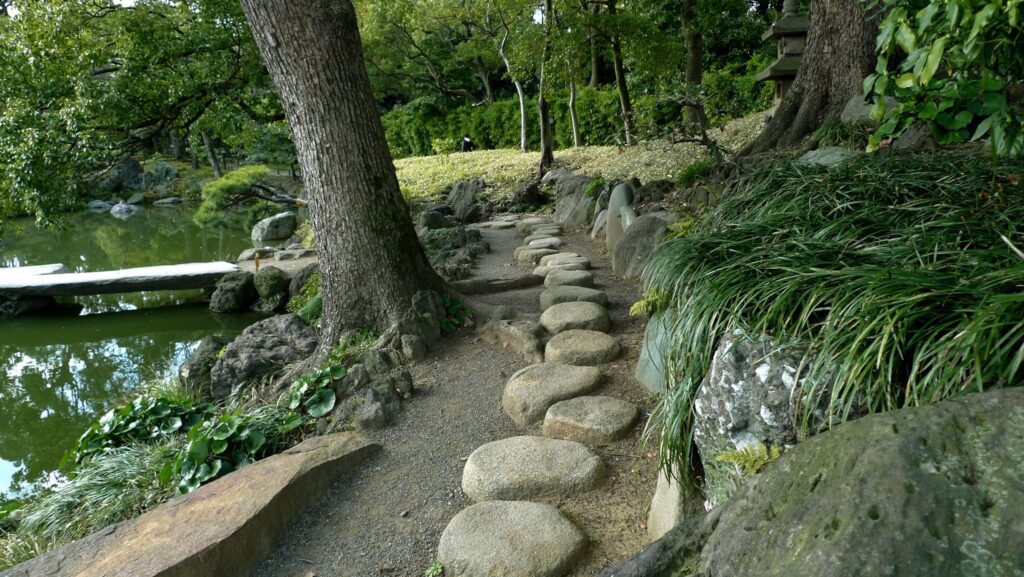
Among all the resonances between hypnosis and the Japanese world, the “Ma” (間), or Japanese interval, figures prominently. Present in the arts as well as in everyday life, the “Ma” is first and foremost felt. It’s a pause, a breath, a suspended time rich in creativity. Because of its link with the hypnotic state, I devote an entire chapter to it in my book Hypnosis-Japan, Encounter en resonance.
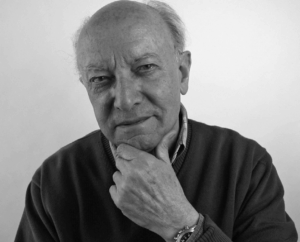
In order to better approach and understand what “Ma” is, I drew on a variety of sources, and was particularly interested in Teddy Peix ‘s artistic work and philosophical research on the subject. In November 2025, I was lucky enough to meet him in Japan, in Kawaguchi-ko, near Mount Fuji, and to attend two conferences on this theme, illustrated by numerous photographs. I’m delighted to present these two lectures, preceded by an interview on his career as an artist. Many thanks to Teddy Peix for the clarity and depth of his words!
Interview: presentation and references
The interval of a step: an artistic itinerary. Teddy Peix, artist
In this interview, the artist and researcher looks back on his journey of study and artistic experience, which led him to research into meditative walking and Japanese philosophy. He explores the concept of ma (間), the interval, through video, photography and writing. His work reveals how walking in a natural environment becomes an experience where time dilates and spaces connect. This interview by Bruno Bréchemier introduces two conferences filmed in Kawaguchi-ko in October 2025. Teddy Peix is the author of “Japon : Des jardins aux arts, Espaces et intervalles” (L’Harmattan, 2023).
Conference : The Japanese interval: creative space, relationship and place of consciousness
Part 1: From physical space to human experience
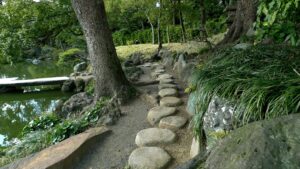
This first lecture explores the genealogy of the Japanese concept of ma (間), the interval, from its appearance in the 12th century to its modern theorization. How was this notion, which naturally unites time and space, rediscovered by twentieth-century Japanese thinkers through contact with Western phenomenology? From Japanese gardens to Takemitsu’s compositions, from Noh theater with its senu hima (interval of non-interpretation) to architectural spaces, the interval reveals a dynamic void where an aesthetic of silence and suspended movement unfolds. This particular logic of mediation runs through the Japanese arts with remarkable coherence, privileging kinesthetic and inner experience, where form and absence, action and non-action coexist in fluid transitions.
Part 2: Place of consciousness and the paradoxical logic of the interval
This second lecture explores a singular philosophical sensibility of space-time and relationship through the thought of Nishida Kitarō, Mori Arimasa and Yamauchi Tokuryū. How can we think of a space-time that precedes the individual and gives rise to relationships? Nishida’s theory of nested places (basho) reveals an absolute present as a place of creative indeterminacy where opposites coexist. The Buddhist tetralemma developed by Yamauchi sheds light on this paradoxical logic of “double affirmation”: the interval separates while connecting, simultaneously embodying affirmation and negation. From Mori’s “binomial relationship” to contemporary applications in hypnotherapy, this philosophical exploration goes beyond the strictly Japanese framework to offer an alternative to Western dialectics, revealing a universal wisdom in which spaces of mediation become the very conditions of our humanity.
Works by the artist
- Films by the artist on Vimeo: https: //vimeo.com/user2603106
- Works visible on instagram : @teddy_peix
- Ki no kioku” (“Tree memory”) series also on instagram : @kinokioku
- Acousmatic music / soundscapes: https: //sonus.ca/resultats/teddy%20peix
Works
- Co-author in “Bulletin of the Nanzan Institute for Religion and Culture 49 (2025)”. h ttps://www.amazon.co.jp/Bulletin-Nanzan-Institute-Religion-Culture/dp/B0FB3DWVJX
- Author of “Des jardins aux arts, Espaces et intervalles” (2023): https: //www.editions-harmattan.fr/catalogue/livre/japon-des-jardins-aux-arts/873#
- Co-author of “Du quotidien dans le cinéma japonais (et français)” (2022): https: //www.editions-harmattan.fr/catalogue/livre/du-quotidien-dans-le-cinema-japonais-et-francais/6859
- Co-author of “Relations artistiques entre la Corée et le Japon aux XXe et XXIe siècles” (2022) : https://www.editions-harmattan.fr/catalogue/livre/relations-artistiques-entre-la-coree-et-le-japon-aux-xxe-et-xxie-siecles/7336#