


The Japanese termikebana is made up of two characters: ike means to live, to be alive or to give life, and bana means flower. Thus, ikebana expresses the art of bringing flowers to life. Far from being a simple floral decoration, it focuses on revealing the essence of the plant, its movement, rhythm and vital force. The arrangement of flowers is a conscious act, in which the human being enters into a dialogue with nature.
The history of ikebana
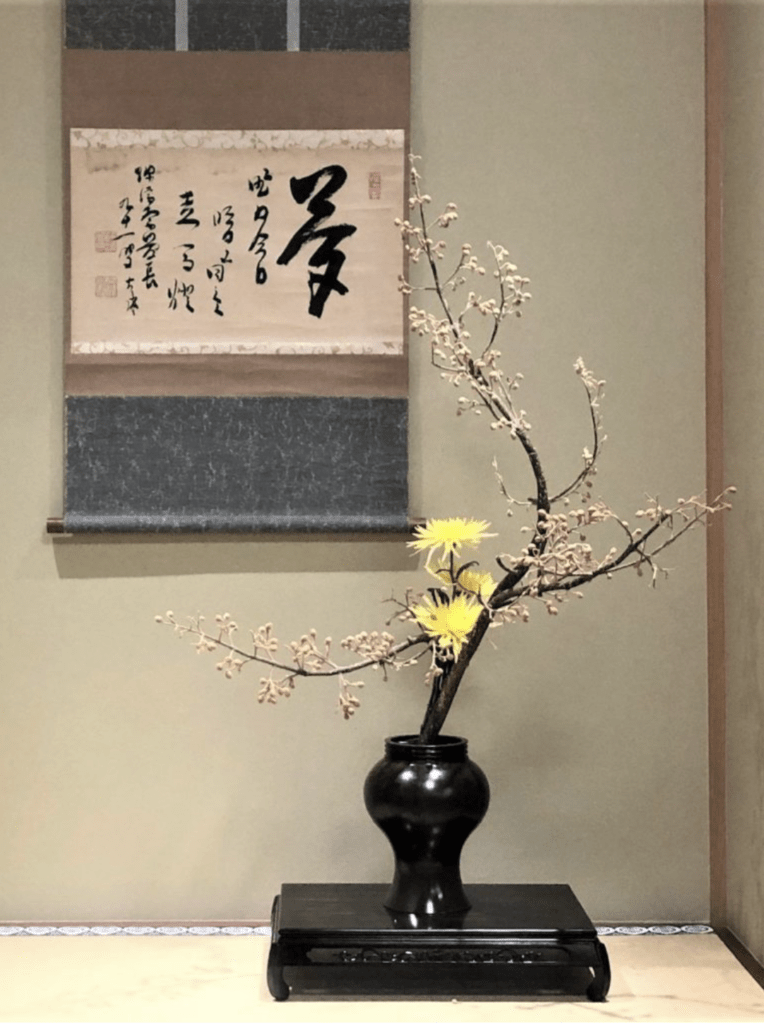
Ikebana is one of Japan’s most emblematic art forms. It illustrates a unique relationship between man, nature and spirituality. Its history dates back to the 6th century, when Buddhism was introduced to Japan during the Asuka (538-710) and Nara (710-784) periods. At that time, flowers were mainly used as religious offerings to Buddha, following influences from China and Korea.
The act of arranging flowers was not an art in itself, but a ritual gesture intended to honor the deities. During the Heian period (794-1185), aristocratic culture developed and flowers became a symbol of refinement. They were omnipresent, not only in homes, but also at the heart of medieval literature. Works such as the Dit du Genji and the Makura no sōshi (Bedside Notes) bear witness to the importance attached to the ephemeral beauty of flowers and the celebration of the seasons.Ikebana was not yet codified, but the idea of harmony and contemplation began to emerge.
With the rise of Zen Buddhism during the Kamakura (1185-1333) and Muromachi (1333-1573) periods, a sober, meditative aesthetic took shape. Floral arrangements became more minimalist and symbolic, reflecting nature in all its purity. Styles such as rikka, with their majestic verticality, appeared in temples or at tea ceremonies, marking the birth of a spiritual dimension in floral art.
From rules codified
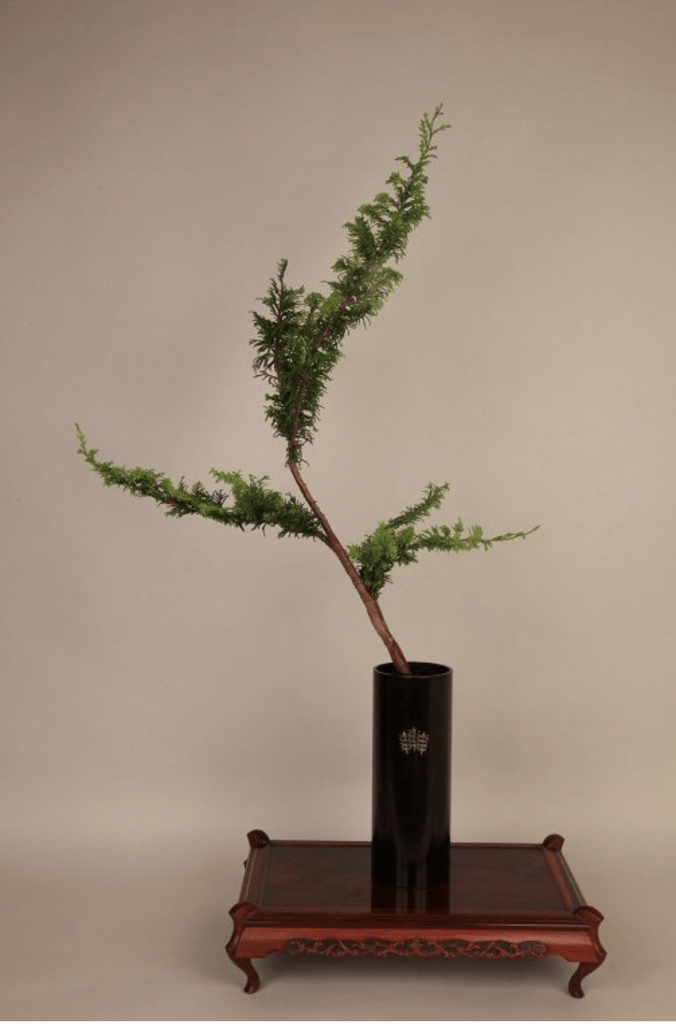
During the Edo period (1603-1868), Japanese flower arranging evolved from a relatively free practice to an organized discipline, taught according to precise, recognized rules. The position of flowers and branches, their length, inclination and relationship to each other are no longer left to chance. Each gesture carries an intention and a meaning within the composition, which follows a symbolic structure and embodies cosmological principles: the sky, universal axis, represented by the main branch; the earth, vast matrix where life is anchored, materialized by a second branch that ensures balance in the vase; man, active mediator between these two poles, suggested by a flower. This codification led to the emergence of identifiable styles, and went hand in hand with the creation of schools (ryūha), whose teaching was transmitted from master to disciple. Knowledge was recorded in manuals, diagrams and treatises, but was also transmitted orally and esoterically. It’s important to stress, however, that “codified” does not mean “fixed”. While the rules serve as a framework, within this framework the practitioner is free to express his or her personal sensibility. Mastery of the codes is an essential step towards true creative freedom.
When art becomes a path
In Japan, certain artistic disciplines are part of a notion of “way”:ikebana is not simply a floral art, it is also Kadō, literally the way of flowers. The character dō means “path”. It is found in many Japanese practices: kendō (sword way), sadō (tea way) or shodō (writing way). A way unfolds as a long, recurring and concrete path, deeply rooted in daily life. It invites the individual to leave the mental world behind and merge into an absorbed presence, attentive to the moment, from which we draw creative energy. Through the intuitive choice of a stem, the acceptance of imperfections and impermanence, the path of flowers opens up the possibility of experiencing each composition as a unique and whole encounter, without artifice. Here, it’s not a question of bending nature to our will, but of feeling it vibrate, welcoming it and letting it blossom on its own. According to neuroscientists, this approach has a positive effect on both body and mind. Certain areas of the brain linked to critical analysis and mental activity, such as the prefrontal cortex, fade away somewhat, while sensory perception networks are awakened and strengthened. This dynamic promotes cerebral plasticity, enabling the creation of new connections and the liberation from rigid patterns. Practising one of these traditional Japanese disciplines thus reveals its full significance.
The ethics of gesture right
Philosophically speaking,ikebana does not seek to produce beauty, but to readjust our relationship with reality. It is part of an ethic of the right gesture: neither domination nor abandonment, but an attentive presence to what is there. In a world saturated with objects, images and willpower, the way of flowers reminds us that meaning is born less from accumulation than from agreement with the living. This posture is not decorative; it is profoundly political, in the noble sense of the word. Finally,ikebana rehabilitates an idea that has become almost subversive: human transformation doesn’t need noise. It can be slow, silent, without slogans or promises. A flower moved with the right touch doesn’t abolish the tensions of the world; it transforms, imperceptibly, the person who replaces it. And this change, repeated day after day, sketches out another way of living in the present.