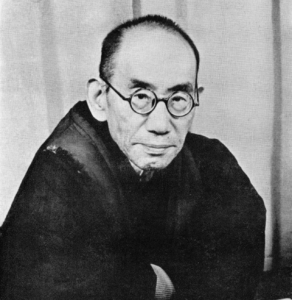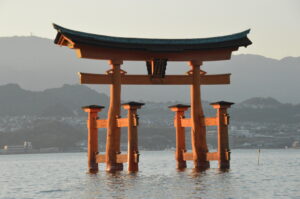


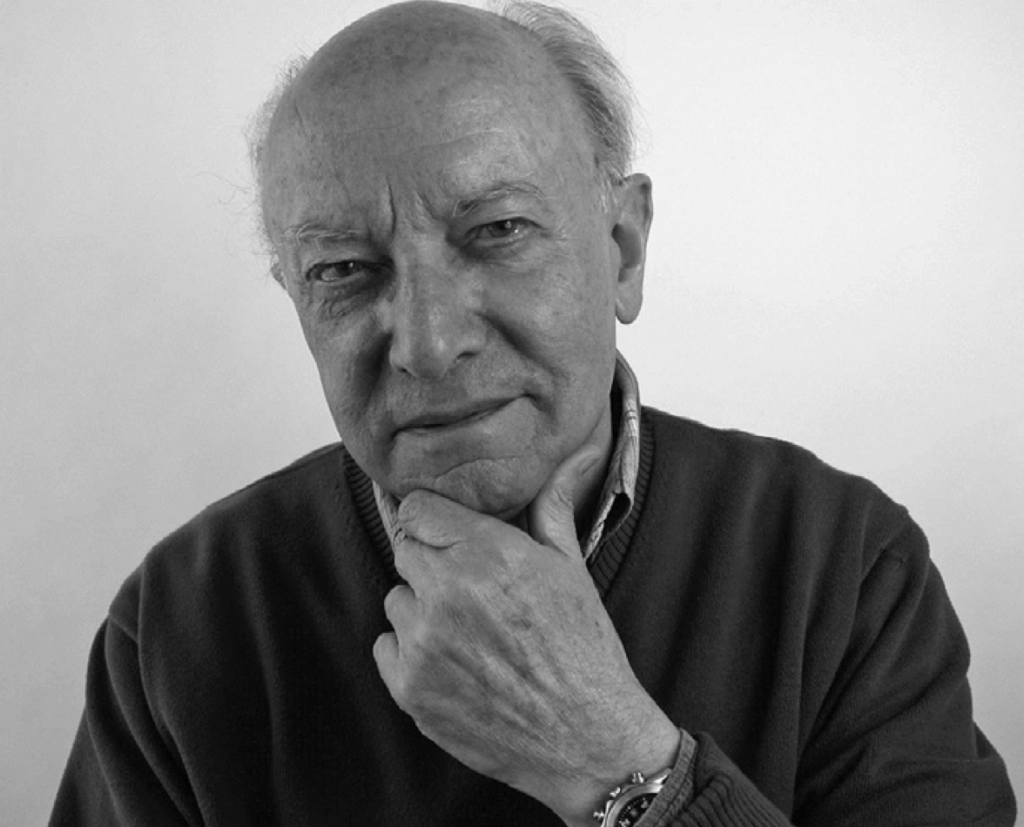
François Roustang is undoubtedly the most Eastern of all thinkers on hypnosis. By inviting us to “let ourselves be carried by life,” he joins the spirit of non-action so dear to East Asian philosophy. His fluid approach, grounded in presence and in listening to the natural movement of things, echoes the Japanese sensibility I explore in Hypnosis–Japan. In both cases, the aim is less to control than to enter into resonance.
He was undoubtedly one of the first to sense that at the heart of hypnosis lies a space – a living interval – where everything becomes possible. By inviting us to “do nothing” and “let ourselves be”, he was perhaps unknowingly joining the Japanese spirit of the fertile void, of breathing between two gestures, of the silent presence that connects beings and things.
Hypnosis that allows emergence. Between speech and silence, between the therapist and the person, the same space of resonance is created where transformation takes root.
In this article, we take a look at ma, a Japanese concept often translated as interval, in-between or space-time. It is one of the fundamental elements of art and culture in Japan, the very foundation of the environment, artistic creation and daily life, to the extent that architecture, music, poetry, theater, garden art and the tea ceremony are all called “ ma arts”. We’ll see that it resonates with hypnosis, and in particular with the thinking of François Roustang. Ma is spelled 間, a character representing a double door (門) through through which sunlight passes (日).
Ma, the suspense
As François Roustang wrote in his first book on hypnosis, this practice is based on “the suspension of submission to the categories of space and time“ .1 This definition can also be applied to Japanese ma, a sensitive interval characterized by a modification of spatial and temporal perception.
A few years later, he added: “ Hypnosis is a state of suspense where everything is possible and nothing has yet begun. A state of suspense in which new connections are possible. This is what defines hypnotherapy. 2 “ This state opens the way to change, made possible by the tuning and trusting relationship with the therapist. When ordinary consciousness and thoughts are put to sleep, the double door of space and time is opened, giving access to another way of perceiving reality, of being in relationship with oneself, with others, with the world. A space-time interval opens up within, a space of subtle perception that the Japanese call ma.
Ma (間) is a bridge that connects and unites space (kūkan, 空間) and time (jikan, 時間) into a single reality. More than a concept, ma is a sensitive reality — it is something to be felt above all else.
This suspension can arise spontaneously — when one detaches from the external world to become absorbed within oneself — or intentionally, within the framework of hypnotherapy.
The doors of hypnosis then open gradually, as the patient enters this state of suspension, this ma. Everything is experienced in a fertile present, where inner time and space intertwine to give birth to a new subjective reality.
In hypnosis, the subject becomes the creator of their own perception of time and space, thus opening the way to the desired transformations.
The Japanese arts give life to ma, a space-time that connects and reveals.
Ma, at the heart of Japanese art
To speak of hypnosis as a therapeutic art makes perfect sense when you read L’Art de l’hypnose avec François Roustang by Dr. J.M. Benhaiem.3 This book traces with finesse the career and thinking of this tireless researcher, whose approach continues to nourish contemporary practice. The friendship between the two men, the depth of their dialogues, the joint preparation of seminars – some of which I was fortunate enough to attend – weave the fabric of this fascinating book. One passage aptly illustrates what ma is in the hypnotic experience: “In everyday life, we perceive only the larger perceptions, whereas in the hypnotic state, we are put in touch with the smaller perceptions, those that are indispensable if we are to perceive and understand something of the world around us.4 “
This ability to capture the finest sensations is characteristic of the hypnotic experience that “This background is revealed by a suspension of what makes up our everyday existence. We don’t know them explicitly, but by situating ourselves in relation to them, we can resituate our existence. In other words, recourse to this background is essential if any changes are to be made in the course of therapy. 5 “
In Japan, artists let ma express itself freely. They let life emerge in the gaps, the interstices, like the sun’s rays filtering between two half-open doors (間). Letting small perceptions emerge is an integral part of their work. From this delicate attention is born the artistic ma. By broadening our perception, the artists open us up to another way of apprehending reality.
This approach reveals an obvious affinity between Japanese art and hypnosis. An art of the implicit and the suggestive, where the ma manifests itself as a discreet but essential presence. Simplicity, imbued with the spirit of Zen, becomes an art of purity, rich in inner nuances. As in hypnosis, ma suggests without imposing, allowing what is to come to the surface. Japanese art is marked by “ a minimalist aesthetic attentive to what is most tenuous in the living, which praises the small, and even the smallest possible, the praise of less in order to achieve the best, or more precisely, the right 6 “. Just, the word so dear to Roustang. “All artists, poets and writers gain access to reality when they leave logic behind and let their brush or pen invent life.7 ” ” We don’t need to explain hypnosis to them. They know what it is. .8 “
In order to let the ma express itself, Japanese artists often place silence, emptiness and white at the heart of their works. Not as absences, but as fertile presences. Suspended spaces where something can be born. A breath, a quiver, a possibility.
The silence
In music, “faire le ma ” means to mark a pause, a meaningful silence between two phrases. Silence and emptiness, far from being negative in Japan, are the very conditions for the emergence of meaning, breath and connection. This is the essence of artistic ma. In literature, it slips into the silence after the words. A haiku continues to vibrate after its first reading, as it does after the second. It’s not just a blank, but a space for sharing between author and reader. In manga, ma manifests itself in silent boxes or bubbles punctuated with suspension points. It also permeates the performing arts – Nō, Kabuki, Rakugo – where silence becomes a “sound full of ma “, rich in suggestiveness, a clever linguistic ma. These pauses create in the spectator a sensitive disposition to what is about to happen. In cinema, silence suggests without saying. Directors like Ozu Yasujirō have made an art of it, using it as an invisible link between characters. Ma is that discreet breathing that gives relief to the moment, and makes it vibrate.
The void
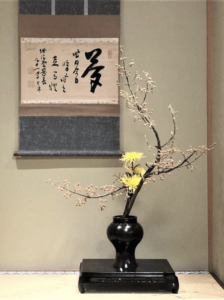
Japanese arts sculpt the void: it’s here that ma reveals itself. In traditional architecture, the empty room – covered with tatami mats, futons stored in sliding cupboards – is not simply a space devoid of content. It’s a place of calm, of breathing, of potentiality. An emptiness that welcomes and enables transformation, meditation and movement. This sensibility is also found inikebana – the art of bringing flowers to life”. As Gusty Herrigel writes: “The empty spaces between the plants are as much a part of the composition as the plants themselves. They represent the ineffable, the informal, the voiceless silence. 9 “. This emptiness is not absence, but a discreet, vibrating, energy-carrying presence. So, in vi(d)e, a hidden life unfolds, ready to emerge for those who know how to see, feel and remain silent. In the Zen tradition, it becomes a space of self-denial and contemplation. It opens up to the essential.
White
In Japanese graphic arts, the white of paper is never neutral. In suibokuga works(sumi-e, black ink washes), as in ukiyo-e prints (“images of the floating world”), it often constitutes a clear zone around which the entire work is organized to access its inner dimension. In calligraphy classes, the teacher insists on these “whites”, the empty spaces that interact with the black strokes. Learn to see them, to feel them, to compose with them, to “grasp white space”. This apparent emptiness carries a breath, a meaning. François Roustang, influenced by Chinese calligraphy and his exchanges with Jean-François Billeter, saw it as a gateway to another mode of perception. In Zen, certain questions(kōan) confuse the ordinary mind to awaken intuitive understanding. One of them asks: “What happens to the white of the snow when it melts in spring?”
Japanese art, a privileged gateway to resonance with the soul of the Land of the Rising Sun, also enables us to forge links between hypnosis and Japan, particularly through ma. Having explored ma as a spatio-temporal suspense, then as an artistic principle, we now turn to its third aspect: relational ma.
Ma, the relationship
François Roustang has often said that in hypnosis, “we don’t rely on a theory, we don’t rely on a vocabulary, we don’t rely on an institution, we rely on a relationship.” In Asia, relationships and belonging to a community take precedence over individuality. “Asian thinkers do not center the individual on his or her own person or personality, but link the individual much more closely to the environment and the universe.10 “
The Japanese vision of the world is based on an intimate relationship between man and nature, who coexist like members of the same family. The ma embodies this emphasis on relationship, integrating the presence of the body. In 1978, the exhibition MA – Espace-temps au Japon, organized in Paris by architect Arata Isozaki and philosopher Roland Barthes, introduced this notion to Western art circles. It then travelled the world for some twenty years. “The presentation of artistic ma. appealed to the visual, auditory and tactile senses. It brought together crafts, photos, installations, concerts, theater, dance, everyday objects and projections, in such a way that the audience, as it moves from one element to another, experiences in its body a space-time likely to provoke a serial reaction of the senses.11 “ François Roustang never ceases to say that hypnosis brings us back to our living body, to our sensoriality, and to our relationship with others.
Human betweenness – what happens between two people – is called aidagara (間柄) in Japanese. It includes the character (間), here pronounced aida, as the pronunciation of Japanese characters varies according to context. Japanese psychiatrist Kimura Bin has devoted some fifteen books to this notion of thehuman interlink, including Entre (2000)12, his major work. He draws on the specifically Japanese concept ofaida (間), as well as on the thinking of two philosophers, Nishida Kitarō and Watsuji Tetsurō. Kimura distinguishes two forms ofaida: intra-subjectiveaida (relationship to oneself) and inter-subjectiveaida (relationship to others), which he considers indissociable. Their articulation enables the subject to relate to the world. This approach, at the crossroads of philosophy and clinical practice, sheds interesting light on the practice and understanding of hypnosis, so true is it that “in the human, there is the between, and there is the other” (Kimura).
François Roustang insisted on the importance of context and the therapist’s role in helping the person find their place in their natural environment. He even considered renaming hypnosis ecotherapy. ” To hypnotize someone is to put him back into his environment; it is therefore an interaction of everything he is with everything around him.13 “ Watsuji Tetsurō, quoted above, reflected particularly on the relationship of the human being with his environment. His main work, Fudō 14, explores in depth the dynamic links between man and the natural, cultural and social elements that surround him. In it, he develops the idea that the human being cannot be understood in isolation, but only in his constant interaction with an environment that shapes him as much as it reveals him.
In Japanese martial arts, ma (間) – or aida – refers to the space-time interval between two opponents, but also to the right rhythm of the action. It’s not an inert void, but a living space, imbued with energy (気,ki). To master ma is to perceive with finesse the right moment to act or refrain, to open or close a space, to enter or withdraw. This sensitivity enables a subtle harmony with the other’s movement, far beyond a simple technical confrontation. Eugen Herrigel, in his book Le Zen dans l’art chevaleresque du tir à l’arc15, often quoted by Roustang, illustrates this approach perfectly. He describes how, through years of practice under the guidance of a Japanese master, he learns to feel the right moment – that invisible ma – when the gesture arises of its own accord, without any desire to aim or hit. Archery then becomes a path to inner realization, where the right action emerges naturally from silence and presence.
Ma, in practice
Artists broaden our view by proposing a new way of perceiving the world. In this respect, art acts as a form of hypnosis, awakening in us a creative impulse. In Japan, ma is a veritable modus operandi that creates suspense, introducing subtle gaps and shifts, creating a living relationship between the work and its recipient.
Like Japanese artists, hypnotherapists can invite their patients to enter the ma: a suspended space of silence, emptiness and whiteness, supported by the relational ma ofaidagara. François Roustang emphasized the importance of silence in hypnosis: “Any session that respects the person rests on a foundation of silence.16 “ This silence, he added, gives rhythm to the session and marks a real turning point in the therapist’s practice. Marc de Smedt echoes his words: “Silence is our intimate companion, the permanent background against which everything stands out. A place of deep awareness, it is the foundation of our gaze, our listening and our perceptions. 17 ” But the therapist still has to know how to make room for it within himself, by emptying himself of all thought, moving away from the psychological ego and self-concern. “First of all, our own emptiness as a basis for action. Therapists who are going to receive a patient must let go of their emotions, their personal problems, their beliefs, their habits, too much talking. The emptiness that appears is a space left open, allowing for a possible action.18“
In hypnosis, emptiness is not absence: it is a living environment, a generative foundation, where the imaginary is set in motion, where the unconscious quietly works, where associations take shape. It becomes a space for profound rearrangement, a place of inner transformation. It imposes nothing, but allows everything.
The therapist, in an attitude of full, open, non-intrusive presence, lets what comes emerge. He offers a sufficiently open framework for the patient to unfold his world. He leaves a space between interventions, and respects the patient’saida – his own rhythm, his own temporality. “The relationship between patient and therapist is the laboratory where all the real and possible relationships of the person who lends himself to the experience can be put into action and transformed.19 “… so that he is “… in a favorable state to take up the threads of his existence and weave them anew.20 “.
In the spatio-temporal suspense of ma, silence and emptiness are combined with whiteness, the luminous region itself, that which catches the sun’s rays filtering through the gates of space and time. In certain hypnoses, this whiteness manifests itself concretely in the form of clarity, a blank page, a sensation of pure space. White, candidus, is the color of the candidate, the one who is about to change condition. A color of passage in many rites and mutations of being. White is a place where sparks from the unconscious, intuitions,insights, outbursts and creative acts emerge.
Traveling to Japan is often an experience of otherness, so different is this country. An otherness that transforms and enriches us. And it makes us feel better where we belong. Roustang’s key notion! Finding your place. Digging deeper into this Asian culture, which at first may seem exotic, we realize that in reality, it conceals an inner world that fits subtly with hypnosis, as developed in this article , but also with language, the body-mind relationship, Zen, and other transcultural weavings to which I dedicated Hypnosis-Japan, rencontre en résonance.
NOTES
- Roustang F. (1990), Influence, Les Editions de minuit, p.122.
- Roustang F., quoted by Marie Dalquié, AFEHM 17th Congress, François Roustang’s hypnosis (episode III), Paris, 20/03/2021.
- Benhaiem J.M.(2024), The Art of Hypnosis with François Roustang, Odile Jacob.
- Ibid, p.121.
- Le Pelletier-Beaufond S. (2019), Abécédaire François Roustang, Odile Jacob, p.83.
- Laplantine F. (2017), Le Japon ou le Sens des extrêmes, Pocket, p.92.
- Benhaiem J.M.(2024), L’Art de l’hypnose avec François Roustang, Odile Jacob, p.309.
- Ibid, p.44.
- Herrigel G. (1964), La voie des fleurs, Zen dans l’Art Japonais des Compositions Florales, Ed. Paul Derain, p.50.
- Benhaiem J.M., (2024), The Art of Hypnosis with François Roustang, Odile Jacob, p.178.
- Okano M. (2016), MA ET AIDA, Des possibilités de la pensée et de la culture japonaises, Textes réunis et présentés par Sakae Murakami-Giroux, Fujita Masakatsu et Virginie Fermaud. Editions Philippe Picquier, p.240.
- Kimura B. (2000), L’Entre. A phenomenological approach to schizophrenia, Ed. Jérôme Million.
- Benhaiem J.M. (2024), The Art of Hypnosis with François Roustang, Odile Jacob, p.83.
- Watsuji T. (2011), Fūdo, CNRS Editions.
- Herrigel E. (1998), Le Zen dans l’art chevaleresque du tir à l’arc, Ed. Dervy.
- Roustang F. (2014), Intervision organized by AFEHM, as part of hypnosis training (Hôpital de la Pitié-Salpêtrière).
- De Smedt M. (2018), Eloge du silence, Albin Michel, p.10.
- Benhaiem J.M. (2024), L’Art de l’hypnose avec François Roustang, Odile Jacob, p.313.
- Roustang F. (1992), Influence, Les Editions de minuit, p.163.
- Roustang F. (2000), La fin de la plainte, Odile Jacob, p.181.